


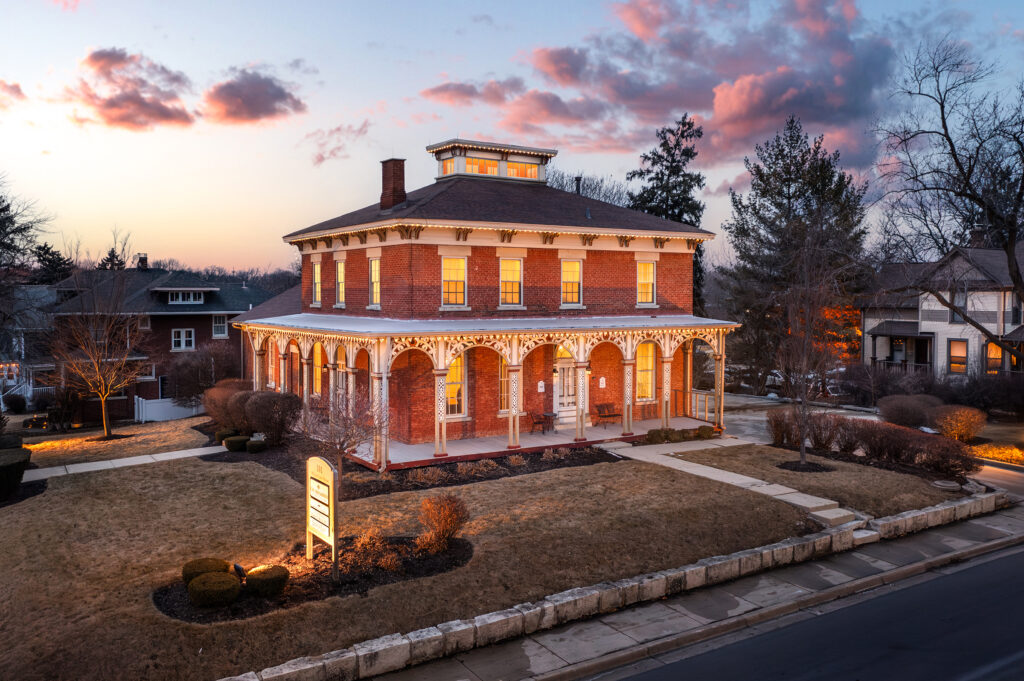
The Ville Team Office in the Willard Scott House located at 101 N. Washington St, Naperville, IL.
In 2025, The Ville Team, a top Naperville real estate team, purchased the Willard Scott House as their new real estate office — ensuring that the iconic home continues to serve the community as a welcoming space that honors the rich heritage of downtown Naperville. Located in Naperville’s historic district neighborhood, the Willard Scott House is a beautifully preserved example of 19th-century Italianate architecture and a cherished piece of Naperville history. Built in 1867, this iconic Naperville landmark has been thoughtfully transformed by each generation of owners, who have maintained its timeless character while adapting it for modern use.
Willard Scott, Sr. Biography
April 20, 1808 (Unadilla, NY) — September 13, 1892 (Naperville, IL)
One of the most colorful characters at Naper Settlement was Willard Scott Sr. In 1826, the Scott family (including father, Stephen, mother, Hadassah, and Willard) traveled by schooner on Lake Michigan, landing ten miles north of Fort Dearborn at Gross Point — now Evanston. They were the first white family to settle there but weren’t satisfied with their selection of a homesite. The Scott men made exploratory trips looking for a more advantageous location.
An excerpt from Scott family historian Etta Cooper Scott in the Naperville Centennial Booklet recounts:
“Willard Scott as a young man in his twenties, was traveling through the countryside seeking a place to live near Naperville. Evening came and he saw a light and went to the cabin and asked for supper and a night’s lodging. In the course of his overnight stay at Pierce Hawley’s cabin, he was taken with Hawley’s daughter, Caroline.
In the morning, after breakfast, Scott thought himself so in love with Caroline that he asked for her hand in marriage. Mr. Hawley had no objection (as Scott seemed honest and upright), but he would have to consult Caroline.
Caroline declined to marry one who she had not met before. Scott said he didn’t expect an instant answer, but would come for an answer in two weeks. (He needed to go to Peoria for a wedding license.)
When he returned, Caroline decided to marry Willard, so they packed and headed to his homesite, five miles south of Naperville. Willard tells of their first night of marriage, ‘We had the sky for a ceiling, the stars for our light, the trees for our shelter, and the ground for our bed.’ Scott enjoyed telling the story, much to the disgust of Caroline who was proud, and ashamed of the way they started.”
In 1830, Willard and his wife Caroline Hawley Scott (whom he had married on July 16, 1829), settled near the forks of the DuPage River at what is now Knoch Knolls. Willard Scott Sr. quickly earned a reputation as one of the most fearless early colonists and was respectfully called “White Eagle,” a title reserved for only the bravest, by both settlers and his Pottawattomi neighbors, who held him in such high regard that they also made him an honorary Indian chief.
In 1838, Willard and Caroline moved to the settlement founded by Joseph Naper and built the Naperville Hotel, a three-story frame building that became a community hub. The couple had five children with only three living to adulthood including Willard Scott, Jr. He grew up to be a prominent figure in Naperville, becoming the city’s first fire marshal and later serving as a village trustee, treasurer, and mayor.
By 1846, Scott, Sr. expanded his ventures into the mercantile business, operating a large department store in the building that later became the north section of the Naperville National Bank. When his son, Willard Scott Jr., returned from serving in the Civil War, Scott Sr. sold him the store and built the Scott Bank just north of it, remaining active in banking until his death in 1892 at the age of 84. Throughout his long and eventful life, Willard Scott Sr. was deeply respected in his community for his unswerving honesty, sound judgment, and scrupulous integrity, leaving behind a legacy that helped shape early Naperville.
Details & Features of the Home
Willard Scott Sr. built the majestic brick mansion for himself and his wife, Caroline, that remains one of Naperville’s finest examples of Italianate architecture. Constructed by William Beidelman and completed in 1867, the stately red brick home was located on what was known as “Piety Hill,” the Franklin Avenue neighborhood named for its many nearby churches. A classic showcase of the Italianate villa style (popular from 1865 to 1885 for its resemblance to traditional Italian country houses) the home’s distinctive wrap-around veranda, bracketed eaves, and elegant cupola, also called a “Belvidere” or widow’s walk, reflect this architectural tradition.
Scott had a lifelong fascination with the sea. As a young man on the East Coast, he once dreamed of becoming a sailor, which may explain his choice to include the cupola reminiscent of a ship’s lookout. According to local lore, residents even climbed the cupola to watch the distant glow of the Great Chicago Fire of 1871.
The mansion’s robust 13-inch exterior walls were built with solid masonry, using three layers of brick. Originally, the home was parged, a technique where a mortar coating was applied over the common brick, then incised and beaded to imitate fine brickwork. This rare method, with very few examples remaining in Naperville today, added to the home’s distinctive charm. Though the bricks themselves were of the common variety, they were painted red and finished with an acid wash, then each brick was meticulously outlined with fine mortar lines by a skilled stone mason using a beading tool. The stone steps, retaining wall, and foundation stones were likely hauled by wagon from quarries in Lemont, as Naperville’s own quarries were not yet operating at the time.
Adding to its Victorian character, the house was adorned with ornate wood scrollwork decorating the wrap-around porch, which extends along two sides of the home. These decorative features were crafted in the shop of Levi Shafer, one of Naperville’s early carpenters. Originally, an iron fence encircled the yard, though it was removed before the Beidelman family later occupied the residence.
The Home Through The Years
The Willard Scott House quickly became a cherished family residence and, over time, adapted to changing generations and new uses while preserving much of its original charm.
Scott Ownership
On January 30, 1867, Willard Scott Sr. and Caroline hosted a grand housewarming for more than 100 local guests, an event fondly remembered in all surviving accounts as a testament to the couple’s prominence in the community and the architectural beauty of their new home. In 1888, when Scott was 80 years old, his grandson Alvin “Bay” Scott and his new bride, Elizabeth Wilson, moved in with Willard and Caroline — following the custom of the time for grandchildren to help care for aging grandparents. The couple may have lived in a private apartment within the house, as later residents recalled that there was once a three-room apartment at the west end of the downstairs.
Following Grandpa Scott’s death in 1891, the “Bay” Scotts soon moved into a home of their own, but the Scott estate retained ownership of the property, renting the main portion and the small apartment to various tenants. In 1919, A.H. Beidelman moved his family into the house, when their home, diagonally across the street, was being remodeled. Learning that a buyer was eager to purchase it, and fearing eviction before his own home was ready for occupancy, Beidelman bought the house.
Beidelman Ownership
Another series of renters lived in the home, after the Beidelmans moved back into their home across the street. And, over time, A.H. Beidelman converted the home from two apartments into three by transforming one of the four upstairs bedrooms into a kitchen. In the early 1930s, Alma Cowey even ran the Satsuma Tea Room in the large downstairs apartment, though her venture was short-lived.
In 1937, A.H. Beidelman persuaded his son Dwayne and Dwayne’s wife Marguerite to move into the downstairs apartment. A bathroom was installed in a large closet off the hallway so the family could have more privacy — prior to that, the two downstairs tenants shared a common bathroom.
Dwayne and Marguerite later purchased the house outright in 1949. A fourth-generation stonemason, Dwayne made numerous changes to the downstairs. He removed the old summer kitchen and back porch to add a large family room and an office for himself when he became superintendent of buildings and grounds at North Central College. He also transformed the small downstairs apartment into bedrooms, turning the main floor into a spacious eight-room family home while preserving the original parlor and sitting room — complete with their plaster walls, window frames, 11-foot ceilings, and sections of wide pine floors. The original front door facing Washington Street turned into a private entrance for the upstairs apartment. And, the former side entrance on Franklin Street was then used as the front door for the Dwayne Beidelman family.
Over the years, the cupola atop the house accumulated a unique record of past residents who scrawled their names and dates inside, including “Bay Scott and Lizzie Wilson – 1887” and others from the early 20th century. It served many uses — the Newcomer family, previous tenants, once turned it into a study nook for their children (carefully painting around the names), and another tenant Vernon Butcher used it as a mini print shop, producing calling cards and programs on a hand press.
Fawell Ownership
In 1975, under the ownership of Harris Fawell, lawyer, former State Senator and United States Congressman, the house underwent a sensitive remodel to transform it into a law firm office. Major structural reinforcement was done in the basement to meet modern safety codes, but much of the home’s original character was maintained. The Franklin Street entrance now served as an entry for clients. The former dining room, with its wainscoting and provincial wallpaper, became the law office’s reception area, and the old parlor became the law library. Additional hallways, offices, and a kitchenette were carved out of what were once bedrooms and kitchens, yet care was taken to retain period details, like chandeliers and decorative prints, to honor the home’s Victorian legacy.
Through more than a century of family life, boarders, apartments, and professional offices, Willard Scott Sr.’s grand brick mansion has remained a warm, welcoming landmark — one whose walls, windows, and storied cupola hold echoes of Naperville’s past and the generations who called it home.
Willard Scott House Timeline
1867 – Willard Scott, Sr.
Built by William Beidelman, grandfather of A.H. (later owner)
1888 – “Bay” Scott & wife moved in with Sr.
1891 – Sr. dies; “Bay” & wife move to own home and rented as 2 apartments
1919 – Alvin “A.H.” Beidelman
Used mostly as a Three-apartment building
1949 – Dwayne & Marguerite Beidelman
Lived in downstairs; converted back to two apartments with the upstairs rented
1975 – Harris Fawell
Adapted it into Commercial building; law offices – Fawell, James & Brooks
Through those 50 Years it stayed a Commercial building; including law offices of – Kuhn, Heap & Monson
2025 – Walt Burrell & Bridget Salela
Commercial building; real estate offices – The Ville Team – Coldwell Banker Realty
Special thanks to Naper Settlement for their commitment to preserving local history and assistance with research and access to archival materials.
Resources include:
The Naperville Sun, September 18, 1981; July 16/17, 1987; May 15, 1969; June 14, 1995; May 29, 1996
Downers Grove Reporter, January, 29, 1959